
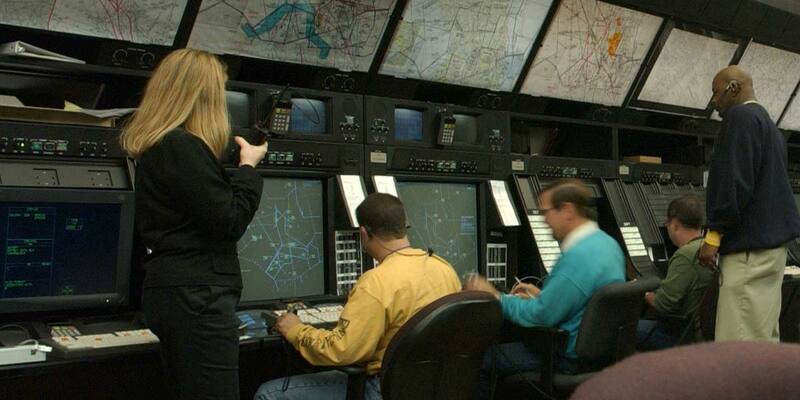
Air traffic controllers at work at the FAA’s Washington Air Route Traffic Control Center, one of the 22 en route centres where SMART is now used. Undated FAA photo. Image: Federal Aviation Administration / Wikimedia Commons, Public domain (US government work), cropped

Every departing flight in the US was held on the ground for more than four hours on Friday, three days after the FAA switched on its AI traffic planning tool across the whole country. The FAA blamed “communication issues” at its en route centres, and Transportation Secretary Sean Duffy told a White House briefing the AI “isn’t plugged in” to the systems that failed.
What happened on Friday
Duffy said radar and radio links at the FAA’s en route centres and TRACONs (the facilities that handle planes approaching and leaving airports) became unstable at 3:36pm Eastern (20:36 UTC). The FAA ordered a nationwide ground stop for all US airports soon afterwards, and Duffy said it lifted it at 8:15pm Eastern (01:15 UTC on Saturday).
More than 3,500 planes were in the air when the trouble began, Duffy said, and controllers brought them down while lifesaving medical and cargo flights and law enforcement kept moving. Thousands of flights were cancelled, and Duffy warned it would take time to unwind.
His explanation was old hardware. The FAA still runs what he called “TDM telecom, so this is analog telecom,” and he said: “Our switches, our routers actually got overloaded with data,” and began sending inconsistent data. The FAA later called it a “temporary telecommunications outage” on X. Duffy said the agency’s new IP switches did not go down, and used the briefing to ask Congress for $50 billion to rebuild the system.
“No possible way”
The timing invited questions. On November 10, the FAA said it would now use SMART, its AI-supported planning tool, in the airspace of all 22 of its en route centres. Asked whether the tool had anything to do with the ground stop, Duffy said it was completely disconnected from the systems that failed:
But that SMART system isn’t plugged in to STARS and ERAM… By the way, if it was, I would tell you that, but this is not even plugged in.
Sean Duffy, US Transportation Secretary
STARS and ERAM are the FAA’s core radar automation systems for airport approach and en route airspace. SMART, Duffy said, only gives a person a prompt, and “the human being will actually decide to accept or deny that prompt.” His conclusion: “there was no possible way SMART would have impacted what happened today.”
Air Space Intelligence, the startup that builds SMART for the FAA, put out its own denial on X at 5:34pm Eastern, while planes were still grounded:
The current ground stop is not based on or a result of the SMART system, any product of ASI or our integration with FAA and ATC.
— Air Space Intelligence (@AirSpaceIntel) November 13, 2026
What SMART does
SMART, short for Strategic Management of Airspace, Routes and Trajectories, was unveiled on September 21 around Washington, DC. It is a cloud-based system that pulls 200 data streams, including weather, flight paths, traffic flow and controller staffing, into one platform, and its “AI-supported engine” predicts where congestion and weather will cause trouble hours or days ahead.
FAA specialists at a SMART centre in Washington check its output and send scheduling suggestions to the agency’s command centre in Warrenton, Virginia, which passes them to local facilities to accept or ignore. The FAA says it cannot take control of an aircraft or replace controllers. By the agency’s own count, it has helped reroute 180 flights since September, saving an average of 10 minutes and almost 80 gallons (about 300 litres) of fuel each.
Air Space Intelligence won the FAA contract for SMART and the command centre’s new data backbone in June. The nationwide rollout went ahead after lawmakers had urged the FAA to pause and evaluate the tool, and the controllers’ union NATCA had complained it wasn’t involved, Flying reported.
What hasn’t been ruled out
The FAA hasn’t published a cause beyond its preliminary statement, and the officials at the briefing were careful about how much they knew. Asked whether a cyberattack or “a rogue AI” could be excluded with certainty, Homeland Security Secretary Markwayne Mullin said: “There’s nothing completely certain right now. It doesn’t appear that way.”
Mullin said there was “no connection between this and Microsoft,” whose outage a day earlier had prompted speculation, and that investigators had seen “zero evidence” of a cyberattack. But he also offered a cause that went further than Duffy’s: as the FAA put “new equipment and new technology” into the system, he said, it “was overwhelming the older system.” He didn’t say which equipment he meant, and neither official tied it to SMART.
Update: Congress to review the outage
Committee leaders in both chambers say they will look at what went wrong, Roll Call reported. Sam Graves and Rick Larsen, the Republican chair and top Democrat on the House Transportation and Infrastructure Committee, called the communication failures “concerning” in a joint statement and said the committee would “thoroughly review the issues that led to this nationwide ground stop.” Neither named a hearing date.
Maria Cantwell, the top Democrat on the Senate Commerce Committee, said the panel is looking into the FAA’s telecoms problems:
Technology issues related to how planes communicate through primary frequencies, backup frequencies, and other issues will be something the Commerce Committee will be reviewing.
Maria Cantwell, Senate Commerce Committee ranking member, to Roll Call
Larsen already had SMART in his sights. On October 13 he and other committee Democrats asked the Government Accountability Office to review the FAA’s safety risk management for SMART, “specifically related to SMART’s AI capabilities”, and how the agency plans to test and certify it. Their letter warned that AI in the tool raised questions about its potential “to interfere with decision-making by experienced air traffic controllers or to hallucinate safety-critical information.” Neither committee statement on Friday’s outage mentions SMART.
The $50 billion Duffy asked for at the briefing is also new: Roll Call says it is $19.1 billion more than the $30.1 billion he and budget director Russ Vought requested in a letter to Congress on Thursday.
Update: Duffy blames an L3Harris router
The Transportation Department has now given its account of what went wrong, and it does not involve SMART. In a release on Saturday, Duffy said a contractor doing routine maintenance at “at least one of our remote FAA locations” was switching telecoms lines from old copper wire to fibre. The contractor was L3Harris, which he said owns the network the FAA uses to control the airspace and has worked for the agency for more than 20 years.
A router installed during that switch “started flooding other routers in our air traffic control system,” Duffy said, with “over 1,000 connection attempts every four to five seconds”, which disrupted communication with aircraft and radar feeds. He said it wasn’t yet known whether the fault was “contractor error or a faulty piece of equipment”, and that once the work at the remote site was isolated, “all of our systems came back online. So, we don’t believe this was cyber at all.”
FAA Administrator Bryan Bedford said the job was ordinary maintenance on the agency’s 1980s telecoms network, where it is replacing 2,000 Cisco routers with Juniper ones, and “not part of” the $12.5 billion modernisation programme run with Peraton. Duffy said the FAA would re-evaluate when it does such switchovers, which it carries out during the day at small sites. Neither official mentioned SMART.
Update: FAA chief sees ‘zero evidence of anything AI-related’
FAA Administrator Bryan Bedford has now ruled out AI on the record. Investigators had seen “zero evidence of anything nefarious, and zero evidence of anything AI-related,” he told Saturday’s press conference, where he put the outage down to faulty equipment, ABC News reported. He didn’t name SMART. On Monday, Homeland Security Secretary Markwayne Mullin floated AI as a possible cause of the week’s outages on Fox News, citing an unnamed tech source.
On ABC’s This Week on Sunday, Duffy said the work was in El Dorado, Arkansas, and that when the new router there was switched on, a system in Amarillo, Texas, replaced about three weeks earlier, “started to flood our system as well.” The Arkansas router is now in an L3Harris lab in Florida, and the FAA is “partnering with the FBI and other law enforcement”, he said. All 69 of these routers in the national airspace have had their ability to broadcast data switched off, which Duffy said resolved the problem.
L3Harris said it was “supporting the FAA in its investigation to understand the conditions that led to the Nov. 13 ground stop.” Hewlett Packard Enterprise, which owns router maker Juniper, told ABC News that “the device functioned as it was configured to by the installer. It did not fail or act improperly.”
Update: FAA says SMART is ‘not related’ and pauses router installs
The FAA has now ruled out SMART by name. On its ground stop questions and answers page, asked whether the AI tool caused the outage, the agency says: “No. The two systems are not related. SMART is a data aggregator, and it does not feed information into the air traffic control system.” It adds that it has “no indication that this was a cyberattack or an outside nefarious actor”, and that operators cancelled about 12,462 flights on Friday, though not all because of the ground stop.
The page says the FAA disabled the faulty function on the routers where the trouble started and, as a precaution, on “more than 60 other Juniper routers in the system, and we have paused installing them.” FAA spokesperson Ian Gregor confirmed the pause on Tuesday, the Associated Press reported, and the agency is relying on older Cisco routers for now while the ones that malfunctioned are tested at L3Harris. Senate Commerce Democrats said only 400 of more than 3,600 new routers had been installed. The FAA and L3Harris are still looking for the root cause.
Why it matters
SMART now feeds AI-backed suggestions into planning for every en route centre in the US, and its first week nationwide ended with the country’s airspace shut. Officials and the company say the AI played no part, and the Transportation Department now blames a contractor’s router; the FAA’s final root-cause finding is the document that will settle it.
Correction: an earlier version put the words “equipment issue” in quotation marks as Bedford’s; ABC News paraphrased him as blaming faulty equipment.
Sources: FAA statement on the nationwide ground stop; US Department of Transportation, Duffy and Bedford update, Nov 14; Transcript of the Mullin and Duffy briefing, Nov 13; FAA, “SMART Expanding Across the Nation”, Nov 10; FAA, SMART launch, Sep 21; FAA, Air Space Intelligence contract, Jun 22; Air Space Intelligence on X; Flying; House T&I Democrats’ letter to GAO on SMART, Oct 13; Roll Call, Nov 13; ABC News, live updates, Nov 14 to 15; ABC News, Duffy on This Week, Nov 15; FAA, Nationwide Ground Stop: Questions and Answers; AP via PBS NewsHour, Nov 17.
Latest Policy & Safety news