
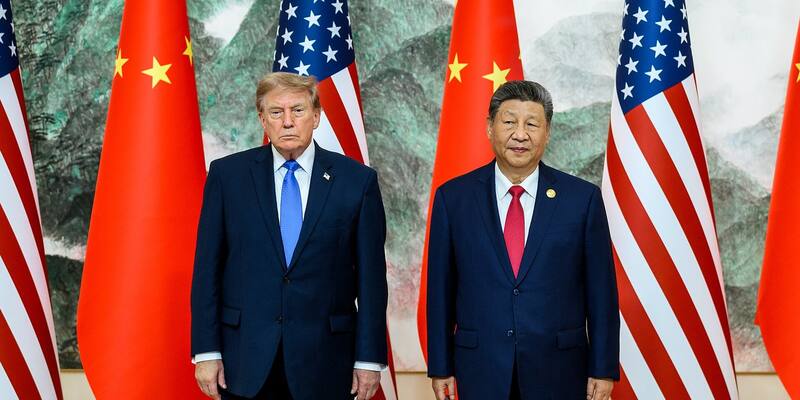
Donald Trump and Xi Jinping before their bilateral meeting at Kylin Villa in Shenzhen, China, on November 19, 2026. Image: The White House (Daniel Torok) / Wikimedia Commons, Public domain, cropped

Donald Trump says American tech companies will not be allowed to build AI data centres in other countries, and will face “a tremendous tax” if they try. He made the threat at a White House news conference on Friday, back from his Asia trip, and admitted he hadn’t yet told his own officials.
“China will take all of them”
Trump framed the plan as a fight with China. He said the US had let the same thing happen with chips, “and it was very destructive to our country”, then told reporters, according to NBC News:
We’re not allowing data centers to go into other countries because China will take all of them, and we’re not allowing that to happen. And we’re going to put tremendous penalties on companies that try and do it.
Donald Trump, US President
He gave no details on how a ban or tax would work, which companies or projects it would cover, or when it would start. The policy appeared to be news to the people standing beside him. “I haven’t even said that to my people,” Trump said, adding, according to CNBC: “But I’m telling them now they’re here.”
In the same breath he urged Americans to accept data centres at home. “Make them pay you, make them pay your community, but don’t shut them off,” he said. Voters turned against several projects in this month’s midterms, in which Democrats won control of Congress.
What it could mean for Big Tech’s builds abroad
The biggest American AI companies all run or are building data centres outside the US, often because governments want data kept in the country. Stargate UAE, a 1GW cluster in Abu Dhabi that OpenAI is building with G42, Oracle, Nvidia, Cisco and SoftBank, was due to switch on its first 200MW this year, and OpenAI has deepened its ties to G42 since. Microsoft has pledged $17.5bn for cloud and AI infrastructure in India, Google $15bn for an AI hub in Visakhapatnam, and Amazon $35bn for India by 2030. Microsoft also took spare capacity at Nscale’s site in Norway after OpenAI pulled out.
Projects like these sit at the heart of the “sovereign AI” deals many countries now insist on (our sovereign AI explainer lists them by country). Microsoft, Google, Amazon, Meta and OpenAI hadn’t commented on Trump’s remarks by Friday afternoon.
Trump didn’t say what legal power he would use. New taxes normally have to pass Congress. The threat also cuts across his own trade pitch: at the same news conference he boasted that the Philippines and Malaysia had agreed to use US technology and services for their cloud infrastructure, and his administration has spent the year promoting exports of the full American AI “stack”. On Monday it closed the loophole that let Chinese firms rent top US chips in data centres abroad.
“Joint guardrails” with Xi
Trump also said he and Xi Jinping, whom he met in Shenzhen on Thursday alongside Vladimir Putin, would work together on AI safety. Xi likes Trump’s term “super intelligence”, he said, then added, according to NPR: “Problem is, it may be too super. So, President Xi and I agree that we’re going to do some joint guardrails, the two of us.”
It is a shift in tone. After Xi’s White House visit in September, when Xi said AI must stay “under human control”, Trump said he would “rather not integrate” with China on AI because the US was “leading by a lot”.
Treasury Secretary Scott Bessent gave the only detail so far. He told CNBC, as reported by the Korea Times, that the two leaders had agreed limits on AI in war:
President Trump and President Xi agreed that humans should always be involved in any military decisions that SI makes, and the SI should not be allowed to be autonomous for major military actions.
Scott Bessent, US Treasury Secretary, to CNBC
Bessent called America’s AI labs “our shield against SI”. Neither government has published a text of the understanding. Trump also announced a “Quad SI accelerator” with India, Japan and Australia to develop superintelligence “that serves our common interest”.
Why it matters
Most of the money in the AI boom is going into data centres, and a growing share of it is being spent outside the US. A ban or a punitive tax would upend deals from Abu Dhabi to India, but until Trump says how it would work, it remains a threat rather than a policy.
Sources: AP; NBC News; CNBC; NPR; Korea Times (Bessent’s CNBC interview).
Latest Policy & Safety news