
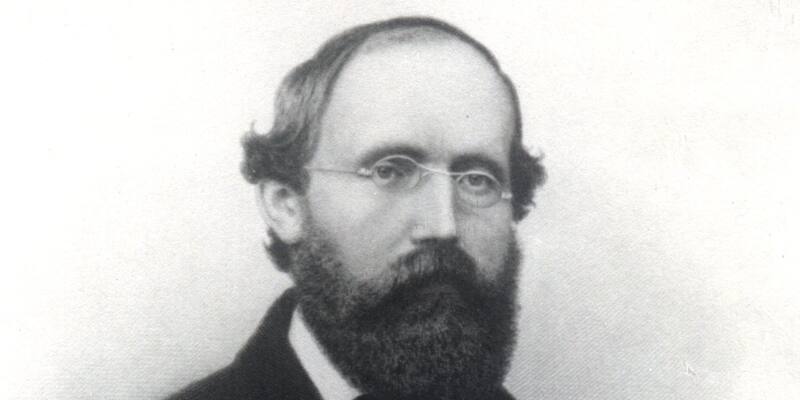
Bernhard Riemann, who posed the Riemann Hypothesis in 1859, in an 1863 portrait. Image: Smithsonian Institution Libraries / Wikimedia Commons, No known copyright restrictions (Flickr Commons), cropped

Levent Alpöge, a mathematician at Anthropic, claims to have proved the Riemann Hypothesis, the most famous unsolved problem in mathematics, with Claude doing much of the heavy lifting. A four-page note that appeared on Friday on Alpöge’s personal website says the proof exists only as machine-checkable Lean code for now, and no outside mathematician has confirmed it yet.
What the note claims
Bernhard Riemann posed the hypothesis in 1859. It says that all the “nontrivial” zeros of the Riemann zeta function sit on a single line, which in turn means the prime numbers are spread out about as evenly as they possibly could be. Thousands of results assume it is true, and it is one of the Clay Mathematics Institute’s seven Millennium Prize Problems, each worth $1 million (about £760,000).
The note carries no name, but it is written in the first person and sits on Alpöge’s own site. It opens with the claim in plain words:
I believe I have, working with Claude, discovered a proof of the Riemann Hypothesis.
The unsigned note on Levent Alpöge’s website
It goes further. The note says the same method “easily extends much further”, resolving the Generalized Riemann Hypothesis, which covers a whole family of related functions, and that it expects to reach the Extended Riemann Hypothesis “with more time”. It says “Claude and I have also formalized the arguments without assumptions.”
“Claude flew, and danced, and sparkled”
The note gives Claude unusual credit. It says the author spent years as a student preparing for this one problem, steered the work towards the right setting, and then watched the model take over near the end:
Claude and I have had a great time together with such breadth in recent months, but this time Claude far outpaced me near the finish line. No, Claude flew, and danced, and sparkled near that finish line.
The unsigned note on Levent Alpöge’s website
The key step, it says, was Claude’s idea for how long to make a chain of “theta lifts”. A 20-step timeline, which the note says Claude compiled, runs from Oct 6 to Nov 16, when the general version was reached. The author admits having “little mastery” of some of the machinery Claude used, and says “this all happened” late on Sunday night, followed by a message to “Dario” about whether it could be announced. Anthropic’s chief executive is Dario Amodei, though the note doesn’t give a surname.
It also expects suspicion: “There is an obvious cynical view, to do with the timing, but it is false,” it says, without spelling that view out. The note appeared the day after Anthropic’s shares started trading. Anthropic hasn’t commented publicly on the claim.
Why the Lean code is the real test
There is no paper. The note calls the argument “incredibly long” and says it would be wrong to post “some massive unreadable travesty of ‘slop’”, so only the Lean files are out, split into 14 compressed archives on the same site. A footnote says the drafts ran past 250,000 pages; a readable write-up is promised later.
Lean is a language in which a computer checks every logical step of a proof, so a finished formalisation is strong evidence, but only of what it states. Outside experts now need to build the code, confirm that its final theorem really is the Riemann Hypothesis rather than a subtly different statement, and check it uses no extra assumptions. The note gives no build instructions or list of the axioms used, and no independent expert had publicly confirmed any of this by Friday afternoon. Even if it holds, Clay’s rules say a solution must be published, then generally accepted for at least two years, before the institute will even consider it.
A year of AI maths claims
Alpöge has been close to several of this year’s biggest AI maths results. In August, Anthropic said an unreleased Claude model raised a long-standing lower bound on the share of zeta zeros that sit on the line from 41.6% to 67.2%, a result Alpöge helped check. In October, Anthropic posted a Claude-written paper claiming to refute the Exponential Time Hypothesis, and OpenAI’s dump of 722 AI-written papers included one on where zeta’s zeros cannot be. Alpöge also worked with NYU’s Tristan Buckmaster on fluid equations before OpenAI announced its own Navier-Stokes result, which set off a public row over credit.
Update: an MIT mathematician says the Lean code compiles
The first outside checks have come back positive. Andrew Sutherland, a number theorist at MIT, told Scientific American on Friday that he had independently compiled Alpöge’s result in Lean. “This is indeed an historic moment,” he said. “The world has changed… to me this is a human triumph, and a day for celebration.” He added that “there is much work to be done to understand the mathematical details of the proof.”
Mathematician Elliot Glazer, who read the formal statement, said the theorem the code proves really is the Generalized Riemann Hypothesis, the second worry raised above:
1) The formalized statement in Levent's drop is in fact GRH.
— Elliot Glazer (@ElliotGlazer) November 20, 2026
2) Still compiling, will take a few hours, but c'mon, it's gonna compile, obv that was checked ahead of time
3) Technically it could be a Lean bug but frontier models virtually never do that on accident. <<1% it's a bug
Lean experts are still going through the files in public on the Lean community’s Zulip chat, which Manchester number theorist Thomas Bloom pointed people to. Whether the code leans on any extra axioms has not yet been confirmed publicly, there is still no human-readable paper, and Anthropic itself has not commented, according to The Verge.
Why it matters
If the Lean code builds and states the real hypothesis, this would be the biggest result in mathematics in generations, with an AI model doing much of the work. Until outside experts check it, it remains a claim on a personal website, from a researcher at the company that makes Claude.
Sources: Remark (alpo.ge) and its Lean archive (alpo.ge/lean.tar.gz.part01 to part14); Anthropic: Claude has improved on a longstanding lower bound for the fraction of zeros of the Riemann zeta function; Clay Mathematics Institute: Millennium Problems; Scientific American (Andrew Sutherland interview); Elliot Glazer on X; Thomas Bloom on X; The Verge.
Latest Anthropic news