
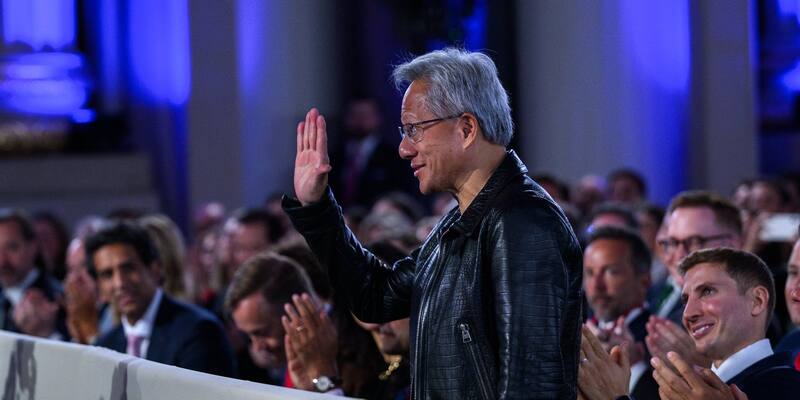
Jensen Huang is recognised by President Donald Trump at the White House AI Summit in Washington, D.C., on July 23, 2025. Image: Joyce N. Boghosian, The White House / Wikimedia Commons, Public domain, cropped

Nvidia’s board has opened an independent investigation into its own chief executive, Jensen Huang, after reports that a suspected Chinese spy got close to him. On the same day Huang told staff, in an email Nvidia has published, that he had been unfaithful to his wife.
The board’s statement, released on Sunday, November 8, says a committee of independent directors, helped by outside independent counsel, will oversee the inquiry “in light of recent reporting that founder and CEO Jensen Huang has been the target of a foreign intelligence effort.” It does not name China, Megaspeed or Alice Huang, the executive at the centre of the reports, who is no relation.
What the board says
“The Board prioritizes U.S. national and economic security, which is paramount to the interests of NVIDIA and its shareholders,” it says. The board “has no reason to believe that either national security or NVIDIA secrets were compromised”, but its inquiry “will examine all available information.”
It also stands by its chief executive. Huang “fully supports the review and has committed to cooperating with it,” the board says, and it “has confidence in Jensen and his leadership team.” It promises further updates “as appropriate” but gives no timetable, and does not say which directors sit on the committee or which law firm is advising them.
Nvidia made clear Huang is going nowhere. “Today’s news will not slow NVIDIA. Jensen is committed to continuing to lead NVIDIA as CEO without interruption,” John Rizzo, its head of public policy communications, told Axios.
“I was unfaithful to my wife”
Huang’s email, under the subject line “A message to our company”, opens with an apology:
I owe my family and all of you an apology. I was unfaithful to my wife. My actions hurt her and our children. There is no excuse for what I did. I am deeply sorry.
Jensen Huang, Nvidia CEO, in an email to staff
He tells colleagues, the board, partners and shareholders that “you deserve better from me” and that he has “fallen short” of his responsibility to them. “Leading NVIDIA is the privilege of my life,” he writes. “I am fully committed to NVIDIA and will work to earn back your confidence.”
The email does not name the woman involved or mention Alice Huang. It turns to the inquiry in one paragraph:
Regarding the national security concerns raised in news reports, NVIDIA’s Board of Directors has initiated an independent investigation. I support the investigation and will cooperate fully. I love our country and our company. I am committed to protecting NVIDIA and supporting America’s national security. I am proud and grateful to be an American.
Jensen Huang, Nvidia CEO, in an email to staff
He ends by asking for privacy for his family: “My family bears no responsibility for my choices. I do.”
From “not unusual” to a board inquiry
When The New York Times reported on October 29 that US intelligence agencies believed Alice Huang, an executive at the Singapore data centre company Megaspeed, had built a close relationship with Huang while passing information to Beijing, the company called his dealings with her “not unusual or unexpected”. Huang himself told Bloomberg they were “completely normal”. Our story on the original report covers what Megaspeed is accused of and how Nvidia, Beijing and the White House first responded.
The claims then grew. The Times reported that a US intelligence memo says Alice Huang was recruited by China’s Ministry of State Security to target the Nvidia boss, and the Financial Times reported that the same memo says the two were romantically involved. The Times has also reported that Secretary of State Marco Rubio warned senior Trump administration officials about the relationship. Neither paper has published the memo, no one has been charged, and China’s foreign ministry has called the reports “smears”.
What comes next
The Republican chairs of three House committees, John Moolenaar, Brian Mast and Rick Crawford, have invited Huang to a closed-door briefing on November 18 and asked him to reply by November 11. Nvidia has not said whether he will go.
The day before that briefing, on November 17, Nvidia reports its third-quarter results, its first earnings call since the reports began. Huang has lobbied hard against limits on selling Nvidia’s chips to China, and the Times separately found that some Chinese firms cleared to buy its H200 chips had empty offices and ties to blacklisted companies, a debate in which Nvidia has been the big winner.
Update: Trump backs Huang as Rubio declines to comment
President Trump has given Huang his full support. Speaking to reporters on Sunday, he called Huang a “fine person” who should stay on as Nvidia’s chief executive, NBC News reported. “I think he’s an honorable guy,” Trump said, adding that Huang had “done an amazing job for our country.” Asked whether he wished he had acted on the intelligence about Alice Huang, he said: “no, I don’t think so.” He also said he would support taking Huang on his upcoming trip through Asia.
Secretary of State Marco Rubio, who the Times says warned senior officials about the relationship, would not discuss it. “I just can’t comment because of the nature of it, and I also can’t comment on an internal corporate matter that’s going on with Nvidia,” he told reporters in Florida shortly after the board’s announcement.
Update: Nvidia shares slide as Beijing rejects the spy claims
Nvidia’s shares fell about 5% in premarket trading on Monday and were last down 4.4% before the US market opened, CNBC reported. China’s foreign ministry spokesperson Guo Jiakun said on Monday that the “so-called Chinese spy narrative” was unsubstantiated, according to Reuters.
Dan Ives, an analyst at Yorkville Ives & Co., wrote in a note that the episode “will create an overhang on the stock” and that there is “clearly risk that Jensen could be removed as CEO depending on the Board investigation”.
Update: Trump says the FBI is looking into it
Trump said on Monday that he had called Huang “to see if he’s feeling all right” and believed his account. “He had absolutely no idea that the person in question was a spy,” he told reporters at an impromptu briefing, NBC News reported, adding: “I really believe him.”
“We’ll look into it,” he said. “I know the FBI is looking into it, in terms of something else, and I think that he’ll be in good shape.” He did not say what the FBI is examining. The Justice Department declined to comment, and Nvidia did not immediately reply. Separately, NBC, citing a source familiar with the matter, says the Justice Department’s National Security Division is running a criminal investigation into Megaspeed over suspected smuggling of Nvidia chips into China, with the FBI and the Commerce Department’s Bureau of Industry and Security. No one has been charged.
Nvidia’s shares closed down 4.2% on Monday, wiping out almost $200bn of its value, on a day the Nasdaq 100 rose 3.4%.
Update: Commerce paused its Megaspeed probe after Nvidia got in touch
The Commerce Department halted its own investigation into Megaspeed after Nvidia’s top lawyer contacted the agents running it, The New York Times reported on Monday. Agents at its Bureau of Industry and Security had spent months on the case, which began in 2024 over suspected smuggling of Nvidia chips into China.
In August 2025, according to the Times, Nvidia’s general counsel, Tim Teter, emailed the agents saying that Jeff Kessler, a senior Commerce official who reports to Commerce Secretary Howard Lutnick, had given the company permission to reach out about the case. The agents declined to meet and passed the emails to Kessler, who told them to handle the case strictly by the book, a Commerce official told the paper. Some officials still saw the contact as a breach that could taint the case, and the Justice Department asked Commerce to pause its work. Commerce complied, and the case moved to the Justice Department, which the Times says is now running a criminal inquiry into Megaspeed.
A Commerce spokesman told the Times the department had handled this and other cases strictly by the book; Kessler did not respond and the Justice Department declined to comment. Nvidia spokesman John Rizzo said the company talks to officials “to answer their questions, provide information we have gathered from the field, request their guidance and instructions and ask whether they have any follow-ups.” A Megaspeed representative said the company was running its own investigation into the diversion claims and had offered to cooperate with the US government without a reply. Megaspeed has denied smuggling chips.
Update: Board hires Wachtell Lipton as a shareholder sues
Nvidia’s independent directors have hired Joon H. Kim, a former acting US attorney for the Southern District of New York, and his firm Wachtell, Lipton, Rosen & Katz “to conduct a thorough and independent investigation as was announced on Sunday,” the board said in a one-line statement on Tuesday. It did not name the directors on the committee. Kim co-led the New York attorney general’s 2021 inquiry into Andrew Cuomo.
Nvidia and Huang also face a proposed class action from investors. Kistenmacher v. NVIDIA Corporation, filed on Monday in federal court in San Jose, says the company failed to disclose that Huang “had an affair with a suspected Chinese spy” and that its statements about its relationship with Megaspeed were “materially false and misleading”. Nvidia hasn’t commented on the suit.
The shares fell again on Tuesday, closing down 5.5% at $168.89, and have lost nearly $450bn in market value over two days, the New York Post reported. In Congress, House Foreign Affairs chair Brian Mast told ABC News he would “absolutely” subpoena Huang if he does not respond to the chairs’ briefing request by Wednesday. Huang has not said whether he will attend.
Update: Trump was briefed on the way to China
Trump was told about the intelligence on Air Force One in May, shortly before Huang joined his trip to Beijing, The New York Times reported on Tuesday, citing people with knowledge of the matter. Rubio delivered the message when he learned Huang would board during a refuelling stop in Alaska; a US government official told the paper he “briefed the president on the issue”. The Times says it was at least the second time in seven months Trump had been told, and that he went ahead with picking Huang up.
That contradicts what Trump said on Monday. Asked whether he knew about the relationship when he left for the summit with Xi Jinping, he replied: “No, I didn’t hear about it then.” Pressed on an earlier briefing, he said: “They could have been mentioned. Certainly, it didn’t make much of an impact on me.” A source told CNN the same account of the May briefing. A White House official told CNN that “these sources have no idea what they’re talking about”, and the State Department declined to comment to the Times.
Trump, who returns to China next week, said on Monday that Huang will not go with him this time. Senior officials also briefed Congress’s “Gang of Eight” intelligence leaders on the matter on Monday, CNN reported. Afterwards Rep. Jim Himes, the top Democrat on the House Intelligence Committee, said lawmakers were trying to find out “whether the decision-making process to export chips was improperly influenced or compromised.”
Update: A Republican senator says Huang has to go
Sen. Kevin Cramer of North Dakota, a Republican on the Senate Banking Committee, has called on Huang to step down, Reuters reported on Tuesday night. The committee oversees export controls and national security reviews of foreign investment. Cramer told Politico late on Tuesday that the affair itself might be the least of it, calling the wider situation “a security risk”:
The potential for extortion is so tremendous that something as sensitive as Nvidia chips, I just think he’s got to go.
Sen. Kevin Cramer, to Politico
Nvidia hasn’t responded to the call. The company has said its board has “no reason to believe” US national security or Nvidia’s secrets were compromised, and that Huang is cooperating with the review. Wednesday is also the day the three House committee chairs asked Huang to reply to their invitation to a November 18 briefing; Nvidia hasn’t said whether he will attend.
Update: Bessent confronted Lutnick over Megaspeed
Treasury Secretary Scott Bessent challenged Commerce Secretary Howard Lutnick in the White House Situation Room over why Megaspeed, the Singapore-based Nvidia customer linked to Alice Huang, is still not on the Commerce Department’s Entity List, Axios reported on Wednesday, citing people briefed on the meeting. The exchange took place on Thursday, November 5. “How come Megaspeed isn’t on the entities list?” Bessent asked, according to Axios; Lutnick stammered, then said: “I don’t know. I’ll look into it.” The New York Times reported the same confrontation later on Wednesday.
According to Axios, White House and intelligence officials have pushed Commerce to act against Megaspeed since the autumn of 2025, and Lutnick has spent the past year “undoing” those efforts, partly over fears a crackdown would escalate the trade war with China. Commerce, Treasury and the White House did not comment to Axios. Megaspeed, which denies diverting chips to China, remains off the list; the Times has reported that Commerce hasn’t added any company to it in more than a year.
Update: Board said to be preparing to oust Huang
Nvidia’s board is preparing to remove Huang as chief executive and could meet as soon as Wednesday to decide his future, The Wall Street Journal reported on Wednesday, November 11, according to Fortune and ABC News. The same day, The New York Times reported, citing people inside the company, that Huang had also had an extramarital relationship with a senior Nvidia executive who reports to him, and that the two were allegedly filmed being affectionate at a hotel during an Nvidia conference in March. The Times said it had not seen the video; ABC News said it could not verify the reporting.
The board was meeting late on Wednesday to decide whether to remove Huang, a source familiar with the matter told Reuters, which said the 11 directors, all independent apart from Huang, can remove him by majority vote with or without cause. Bloomberg reported that the board has worked with an outside firm to find possible replacements, Reuters said. Nvidia did not respond to Reuters on the meeting and had not announced any decision by early Thursday UTC.
The shares, which closed up 2.9% in regular trading on Wednesday, fell more than 8% after hours to $159.51, CBS News reported. The company has no board chair, no chief operating officer and no published succession plan; business and law experts told Fortune that chief financial officer Colette Kress or lead independent director Stephen Neal could step in as interim chief executive. Analysts and investors cited by Reuters named Kress and Ian Buck, who joined Nvidia in 2004 and led its CUDA work, as the likeliest candidates; Josh Gilbert of eToro called Kress “the obvious choice to steady the ship.” Huang co-founded Nvidia in 1993 and has run it ever since.
Update: Shares slide again as Wall Street waits on the board
With no word from the board by Thursday morning, Nvidia’s shares were down 6.4% at $162.62 in premarket trading, Yahoo Finance showed. They hit $156.20 overnight, their lowest since July 2025; by Yahoo Finance’s count that is more than $600bn of market value lost since last Thursday, and about $2 trillion since the record close of $239.24 on October 6. Yahoo Finance, citing the Times, identified the executive in the second relationship as Kimberly Powell, Nvidia’s vice president of healthcare, who has not commented publicly; CNN’s Meg Tirrell said Powell had pulled out of a panel at the Milken Future of Health Summit in Washington on Thursday.
Analysts are turning. Bernstein downgraded the stock to Market-Perform and halved its price target from $400 to $200, writing that “it feels impossible to us for the board to keep him in the role”. Baird had already cut it to Neutral on Wednesday, citing the congressional inquiry and the government investigations. Dan Ives, who on Monday called removal a risk, now sees it as likely:
In our view the writing is on the wall that Jensen’s days at Nvidia could be numbered and we would expect this to be a very fluid situation over the next 48 hours.
Dan Ives, Yorkville Ives & Co., in a note to clients
Wednesday was also Huang’s deadline to answer the three House chairs. Rep. John Moolenaar said on Fox Business that if Huang did not agree to the briefing he would likely be subpoenaed, and Rep. Brian Mast said his committee was preparing one, TechCrunch reported. Nvidia hasn’t said whether Huang replied. Alice Huang is believed to be living in Beijing, and Chinese security officials are aware she is there, Bloomberg reported, according to Yahoo Finance.
Why it matters
Nvidia makes the chips that power most of the AI boom, and Huang is the loudest voice in Washington on how many of them China should get. Until now Nvidia had treated the reports as routine customer contact; a board inquiry, alongside a personal admission from Huang, means it no longer can.
On November 12, Huang resigned as Nvidia’s chief executive, with Colette Kress taking over as interim CEO.
Correction: an earlier version of this article misquoted part of Huang’s email; the quote now matches the text Nvidia published.
Sources: Statement from Nvidia’s board of directors; Nvidia: A Message to Our Company (Huang’s email to staff); Axios (Nvidia statement); The New York Times (Oct 29); The New York Times (Rubio warning); TechCrunch (NYT and FT memo reports); House Select Committee on China (Nov 5 letter); NBC News (Trump and Rubio comments); CNBC (share price, China response, Ives note); NBC News (Trump on the FBI, Megaspeed probe); NBC News (Monday close); Nvidia (Q3 results call); The New York Times (Commerce probe paused, Nov 9); Nvidia: Statement From the Independent Members of the NVIDIA Board (Nov 10); Kistenmacher v. NVIDIA Corporation, N.D. Cal., 5:26-cv-13448 (complaint); New York Post (Tuesday close); ABC News (Mast interview); The New York Times (Air Force One briefing, Nov 10); CNN (briefing source, White House response, Himes statement); Reuters (Cramer’s call to resign, via Yahoo); Politico (Cramer interview); Axios (Bessent and Lutnick); The New York Times (Bessent and Lutnick); The Wall Street Journal (board preparing to oust Huang); Fortune (ouster report, after-hours fall, interim options); ABC News (ouster and second relationship reports); The New York Times (relationship with an executive, Nov 11); Reuters (board meeting, via Investing.com); Reuters (successor candidates, via Investing.com); CBS News (after-hours fall); Yahoo Finance (premarket price, analyst notes, Powell, Bloomberg on Alice Huang); TechCrunch (subpoena deadline)
Latest Chips news